JANM Symposium on Democracy, January 23, 2026
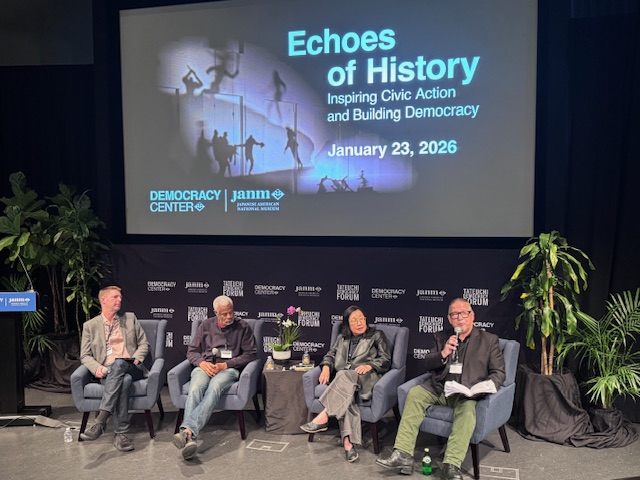
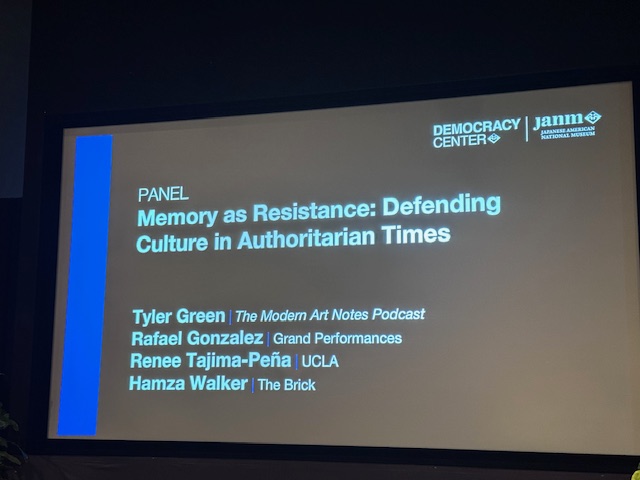
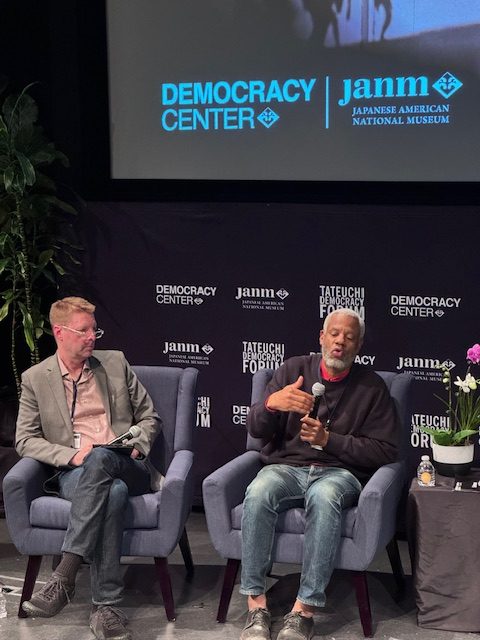
At the Japanese American National Museum’s symposium “Echoes of History: Inspiring Civic Action and Building Democracy,” a panel of cultural leaders gathered to discuss an increasingly urgent question: What is the role of art and culture when authoritarianism threatens democratic freedoms? The conversation, moderated by Tyler Green of The Modern Art Notes Podcast, brought together Rafael Gonzalez of Grand Performances, filmmaker and UCLA professor Renee Tajima-Peña, and Hamza Walker of The Brick. What emerged was not just a discussion of theoretical concerns, but a real-time account of cultural workers navigating immediate threats to their ability to tell stories, preserve memory, and serve their communities.
The Erasure of Stories
Rafael Gonzalez opened by framing the stakes clearly: “We’re talking about erasure.” For Grand Performances, a Los Angeles institution dedicated to free public performances that celebrate cultural diversity, the past year has brought concrete challenges. Artists they planned to present have been denied visas. The administration’s selective visa processing, shutting down applications from what one official called “shithole countries” while fast-tracking athletes for the World Cup and Olympics, reveals a disturbing calculus: certain people can entertain us, but they cannot share their stories or cultures on their own terms.
“What you see on stage is more than just a performance,” Gonzalez explained. “It’s giving the audience a sense of belonging.” When Grand Performances presented Qawwali music, the joy on the faces of Pakistani and Indian audience members was, in Gonzalez’s words, “magical.” This is why the work matters, not as entertainment, but as recognition, as witnessing, as the assertion that these stories belong in public space.
The work isn’t just aesthetic. It’s oral history told through dance, poetry, theater, and music. In an era of book bans and attacks on education, Gonzalez reminded us that stories exist beyond the page, in living performance and communal gathering.
Refusing Compromise
When the National Endowment for the Arts offered grants with the condition that organizations scrub words like “diversity,” “unity,” and “community” from their mission statements, Grand Performances faced a choice. The $80,000 grant would have been significant for their budget. They refused it. “There was no way that we were going to compromise our mission,” Gonzalez stated. “We were going to compromise our relationship with our audience. We’ve been doing this for 40 years.” This wasn’t a gesture. It was a recognition that the integrity of their work—their covenant with their community, couldn’t be bartered. It meant working harder, being more creative, and building stronger coalitions. But the alternative was betrayal.
Arts Organizations as Civic Leaders
Grand Performances also postponed performances in response to civil rights protests in downtown Los Angeles. When asked why an arts organization would involve itself in such matters, Gonzalez’s answer was unequivocal: “The arts has always been part of the movement, and we will not compromise our relationship to that movement.”
This refusal to separate cultural work from civic responsibility speaks to a deeper understanding of what arts organizations actually do. They’re not neutral service providers. They’re civic leaders, positioned at the intersection of community, expression, and public space. When young people exercising their First Amendment rights are met with state violence, arts leaders have both the platform and the responsibility to respond. “We’re very intentional that we are not just arts leaders,” Gonzalez emphasized. “We’re civic leaders, and if we need to make a statement, we will make that statement.”
The Power of Collective Action
Renee Tajima-Peña, speaking from her experience as a documentary filmmaker, noted that approximately 75% of documentaries about Asian American stories have come through public broadcasting, a system now under direct attack. For younger filmmakers asking how to finance their work in this moment, her answer drew from four decades of experience: collective action. She recounted how a small group of Asian American Academy members, in response to the #OscarsSoWhite movement, went to the Academy’s leadership and demanded changes. Those changes had ripple effects throughout the industry, opening opportunities that individual efforts never could have achieved. “That’s the only way we’ve gotten the money,” she explained. “That’s the only way we’ve made progress, not only in the documentary field, but in features.” This isn’t just historical observation—it’s strategic orientation for the present moment. When systems are hostile, when funding disappears, when access is denied, collective organization becomes the primary tool for cultural workers to continue doing their work.
The Long History of Artist-Led Resistance
Hamza Walker began to trace the genealogy of alternative non-profit art spaces back to the 1970s, organizations that were “largely artist-inspired, artist-run.” His the implication was clear: cultural workers have faced these battles before. The infrastructure of resistance, of alternative spaces and independent organizing, has deep roots.
Cultural Architecture for an Uncertain Future
What struck me throughout this discussion was how these cultural leaders refused to separate their aesthetic work from political and civic responsibility. They understand that in authoritarian times, every decision about programming, funding, and positioning becomes consequential. The question isn’t whether art can or should be political, it’s whether cultural workers will have the courage to defend the public spaces where communities can see themselves, tell their stories, and build solidarity. The title of the panel was “Memory as Resistance,” and that framing proves crucial. In a moment when history is being rewritten, when certain stories are being systematically erased from curricula and public discourse, the act of remembering, of presenting, of witnessing, of refusing to forget, becomes a form of resistance itself.
These cultural workers are not just defending their organizations or their programming. They’re defending the possibility of a pluralistic public culture, where diverse communities can gather, where difficult histories can be acknowledged, and where art serves not as decoration but as a vital civic practice. As Gonzalez reminded us, quoting the inspiration of Glenn Kaino’s earlier presentation: “That’s exactly why we do what we do, because it is more than just the preservation here.” It’s about refusing erasure. It’s about collective action. It’s about insisting that certain stories must be told, certain spaces must be held, and certain futures must remain possible.
In authoritarian times, this is what resistance looks like: artists showing up, communities gathering, cultural workers refusing to compromise, and all of us insisting that memory, diversity, and democratic culture are not negotiable.
_______________
The symposium “Echoes of History: Inspiring Civic Action and Building Democracy” took place at the Democracy Center at the Japanese American National Museum on January 23, 2026.