By Alisa Ochoa
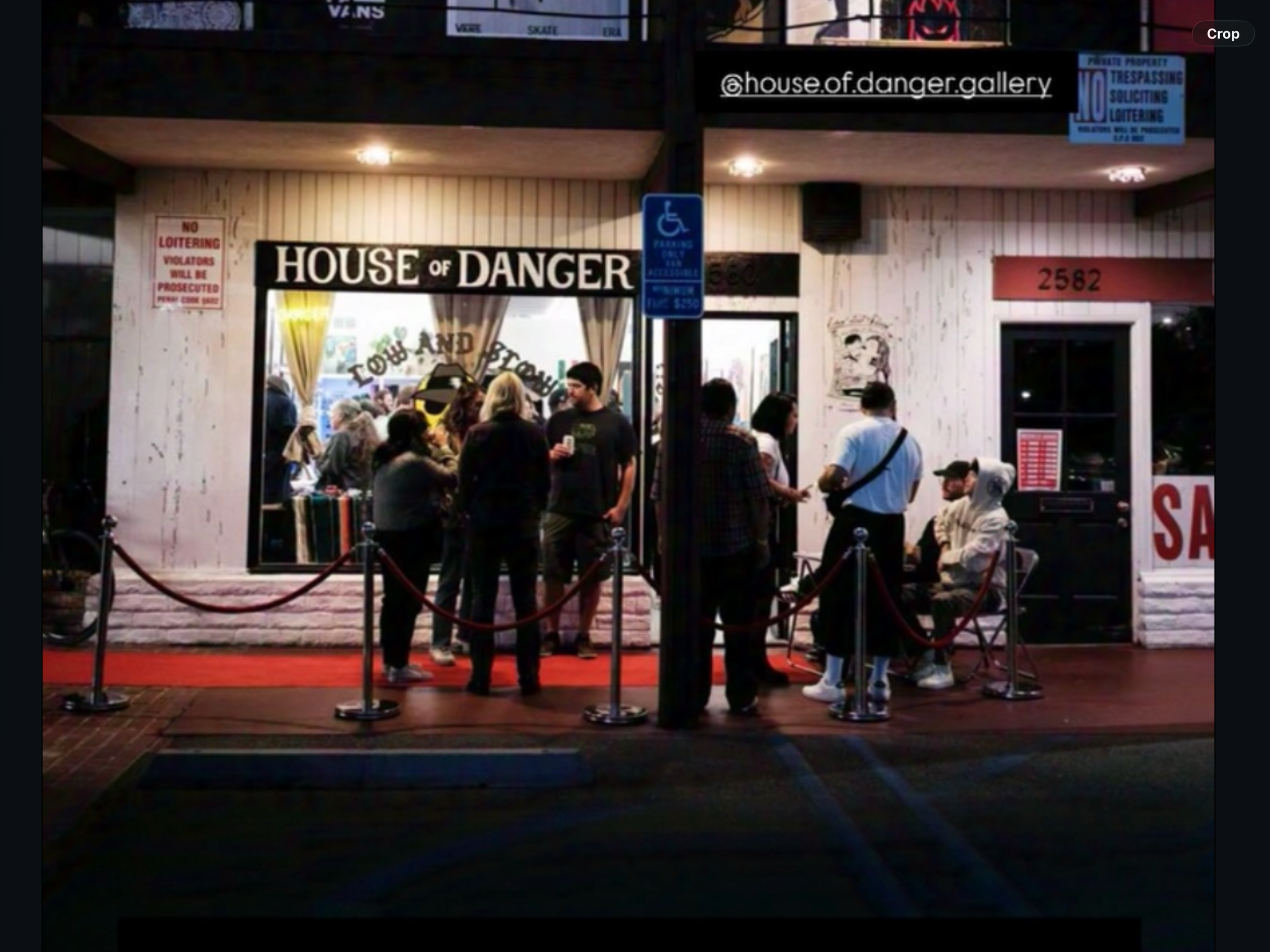
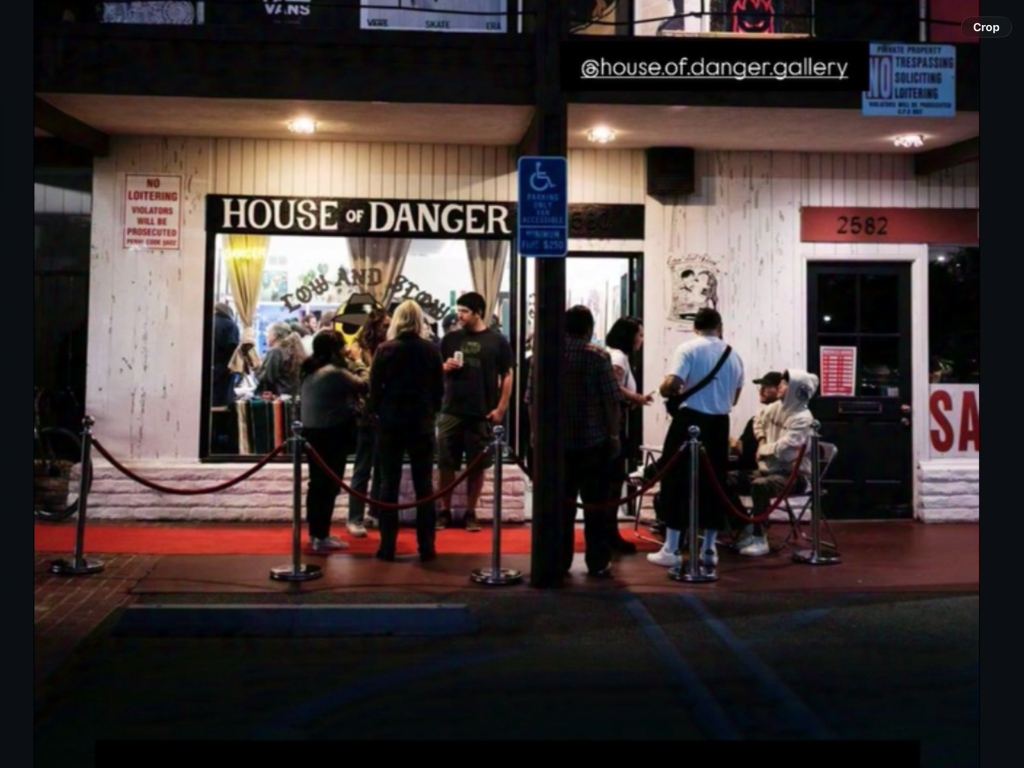
Low and Slow is on view at House of Danger Gallery, nestled in an unassuming shopping center just off the 55, beside a Circle K and below the Attic Skateshop. The space is operated by Jackie Danger, a visual artist and brand strategist who opened the gallery to create exhibition opportunities for the action-sport artists she has long admired.
The exhibition features work by local artists, skaters, and friends Jason Acuña and Jose Cerda. Acuña works primarily in photography, Cerda in painting. Their works, facing each other on opposite walls, create a dialogue across the room — like siblings who share the same DNA yet couldn’t be more different.
(installation photo by Alisa Ochoa)
In Chicano lowrider culture, low and slow means lowering a vehicle (preferably a Chevy) close to the ground and cruising at a leisurely pace, giving onlookers time to appreciate its custom paint, hydraulics, wire wheels, and music. Where mainstream car culture prizes speed, the lowrider is unbothered, moving down the boulevard on its own pace. It is, above all, about style. The same applies in the kitchen, where low and slow builds flavor through time and patience. A lot like artmaking and abuela’s menudo, the best things cannot be rushed.
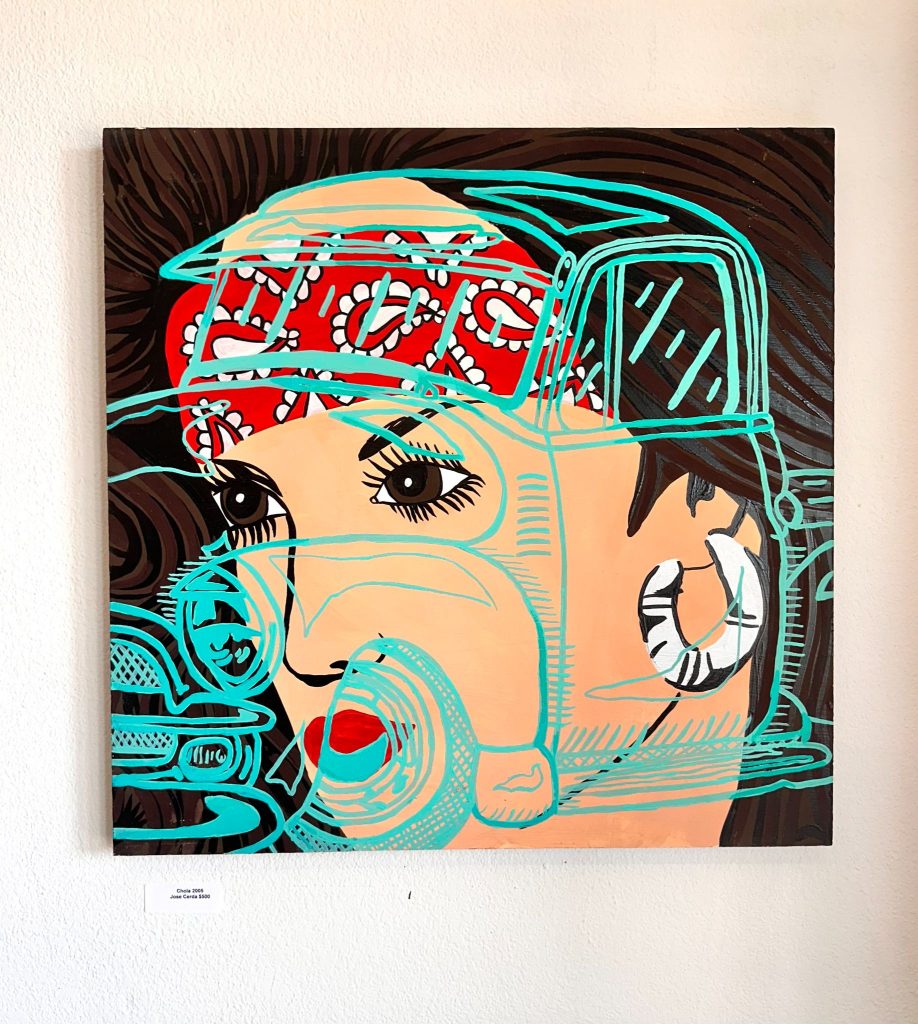
Both artists share Mexican heritage, and for Cerda, it is fully on display. His paintings are composed of bold lines and flat, colorful imagery, reminiscent of band flyers and zine illustrations. A hot pink ‘57 Bel-Air and a blue ‘52 Stepside 3100 pickup, which once belonged to his father, serve as focal points in several panels. In Chola (2005), a partial outline of a lowrider truck frames a close-up of a woman’s face. It feels like a single comic panel pulled from a larger story, charged with suspense. His work carries the energy of postwar pulp novellas, mysterious and devotional at once.
Cerda’s imagery takes me back to the posters my father displayed around our home, among them Jesús Helguera’s iconic 1942 painting of Izta and Popo, which I inherited after he died. According to the artist, this body of work reflects the aesthetic world of his older brothers, who loved lowriders — an influence that has never left him. As a successful pro skater in the 90s, he forged partnerships that translated his artwork into limited-run skateboard decks. The paintings on exhibit celebrate his heritage and the enduring influence of his formative years.
Cerda met Acuña thirty years ago on a sponsored skateboarding demo trip to Hawaii, around the same time he began developing this imagery. They were there to hype up a popular sunglasses brand, and in the downtime, shared meals and conversation. The two have been friends ever since, and the two-person show was their idea.
(courtesy of the artist)
The low of the title may also nod to Acuña’s stature; he has a form of dwarfism. Earlier in his life, Acuña was a pro skater and stuntman, familiar to many from the early-2000s MTV series Jackass. He is still widely known as Wee-Man. His photographs here show a different facet of his life: portraits of strangers and friends alike, each met with the same curiosity and warmth.
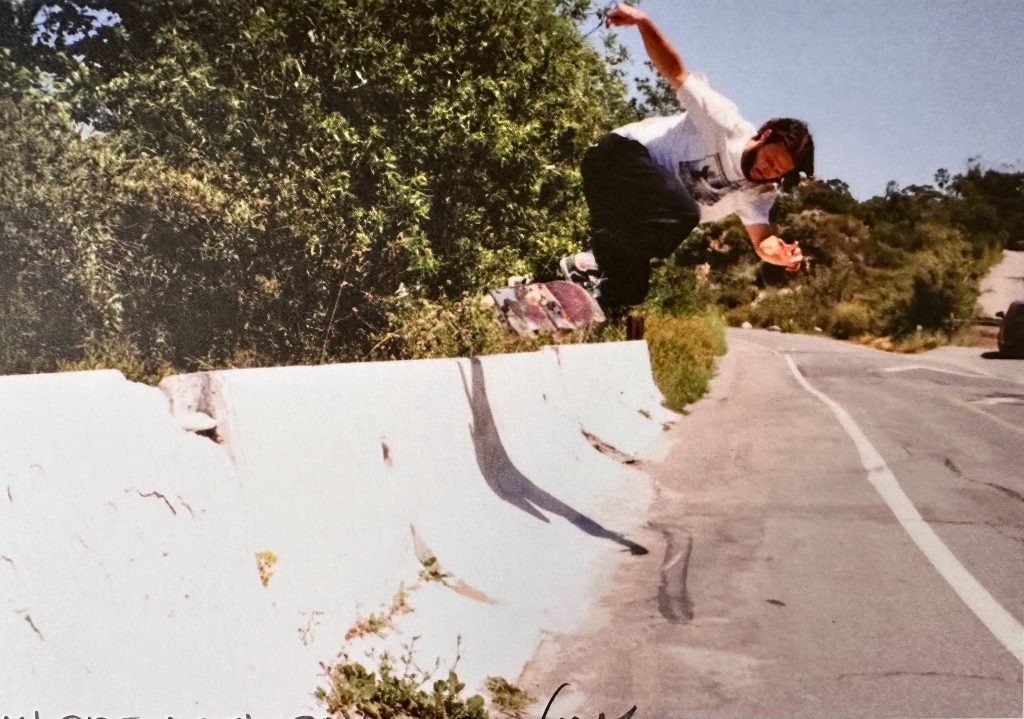
Slow, too, is the process. Acuña shoots on a Canon Elan with 35mm film. Choosing to go analog itself is a statement: nothing is instant, nothing immediately shareable. For a public figure in our era of endless scrollable content, these photographs reveal a kind of intimacy and purpose. The process begins with looking through a viewfinder and ends with a roll of film handed over to chance at Samy’s Camera. In the resulting grid of framed color photographs, the viewer sees the world from his lower vantage point. This is especially evident in Backside at the Bay (2026), which captures a friend mid-air at a favored spot in Newport Beach. In an age of hustle and optimization, going low and slow is itself a radical act, one that reclaims time and gives the imagination room to roam.
I confess I do not skate, but have always admired those who do. Skaters see the built world differently: an empty parking lot, a sidewalk curb, a handrail, all of it an invitation for play. There is something wildly creative in seeing past the utility of ordinary things. A concrete parking block is designed to keep vehicles in place, but to a skater it becomes grist for self-expression, the way any artist finds potential in raw materials. For generations, especially here in Southern California, skating and lowrider culture have been kindred spirits, both driven by creativity, camaraderie, and a life lived on one’s own terms. At its heart, Low and Slow is about friendship.
My favorite art history professor, the late Dave Hickey, would always remind you to make art for your friends, not to fit into art world trends or chase the elusive promise of commercial success. For your friends — the ones who will carry you to the ER when your head slams the pavement. For your homies — the ones who share in your joy of landing a difficult trick after many failed attempts. It’s a message I’ve carried my whole life, and one I find alive and well next door to a Circle K, at the House of Danger Gallery.
Low and Slow closes with an artist panel discussion on May 29th. RSVP is required.
Friday, May 29, 2026
6:00 PM — 10:00 PM
House of Danger Gallery
2580 Newport Blvd.
Costa Mesa, CA 92627
Open by appointment
Alisa Ochoa is an artist, parent, and advocate of Mexican-Thai heritage — equal parts softie and baddie.